http://www.mobilewhack.com/reviews/meet_bob_-_the_future_mobile_home.html
It's not really a mobile home as they say; it's more of a motor home with a few modifications. It's silly, yet interesting.

.jpg)
 held in Austin, Texas. The event was organized by the Manufactured Housing Research Alliance (MHRA) in conjunction with the Manufactured Housing Institute's annual Winter Meeting. MHRA has been working with several manufactured housing factories for the past 9 months for a project entitled "Manufacturing Innovation Through Lean Production." Here's some background on the project:
 In April, delegates from each factory attended a week-long training session in Cincinnati to learn the basics of Lean. Then, we took this knowledge back to our factories and began the long journey of implementing it. Dewey Warden from Senco (a supplier to our industry) and Dr. Mike Mullens from the University of Central Florida worked hands-on with the factories mapping out our value-streams, performing Rapid Process Improvement (RPI) events, and working with management on implementation strategy. This occurred over the course of about 9 months, and is still happening today. Finally, all of the project participants came together in Austin this week to discuss what we had learned during the course of our project. That's the project in a nutshell.Now that that's out of the way, I'd like to give you some of my notes from the symposium:
1) It was great to see good ol' factory guys up on stage, speaking candidly, using PowerPoint, answering questions from the audience, and pretty much enjoying the moment. Also, there seemed to be a genuine appreciation of their effort from the audience.Overall, it was a great experience. I came away feeling that more and more people are picking up on what we're trying to do, and that Lean can be used as a marketing tool in our industry. If people start to associate factory homebulding with Lean, then maybe the stigma of trailer parks
2) Every presentation made the point that there has to be buy-in from all levels for Lean to work. It can't be top down only, and it can't be shopfloor only. Everybody has to get involved in the decision-making process. It was emphasized that one of the difficulties that we've faced was the need for old school authoritarian types to let go of the reins for a minute and let the front-line guys do the driving.
3) There seems to be a consesus by everyone that Lean factory homebuilding has the potential to be the best solution to fulfilling housing needs. Dr. Darlene Williams, the Assistant Secretary of the U.S. Department of Housing & Urban Development, spoke at the outset of the symposium, and indicated that her organization was committed to supporting Lean research in our industry. It was very encouraging.
4) It still amazes me that so many competitors can come together and share ideas, secrets, strategies, and experiences with each other even as the market has become more and more competitive. The idea is that we're entering a new phase in the history of homebuilding, and that we'll all have opportunities to make a difference. It's nice to see such cooperation and goodwill in the corporate world.
5) It's obvious that we have a long way to go before we can say that we know Lean. Some executives have a good comprehension of macro-level principles, and some factory guys have a solid grasp of micro-level techniques, but only a very few people have an understanding of the entire spectrum of Lean the way a Toyota sensei would. Don't get me wrong, it's not rocket science, but there are always deeper levels of undestanding that can and must be attained to become like Toyota.
 and hurricanes will be replaced by a mental association with top-of-the-line manufacturing
  products, like say, the Lexus automobile. Of course, this correlation will never make headway until we make some headway into actually becoming lean. We've got a long row to hoe, but the journey should be enlightening.
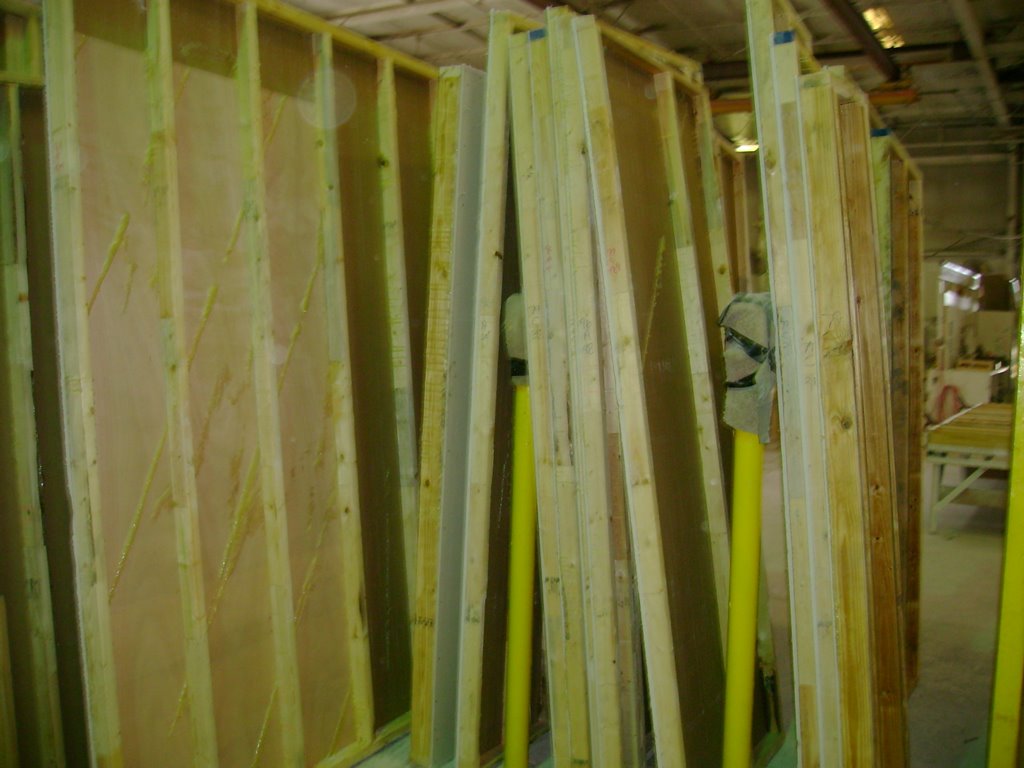 Think about building and setting interior walls. The framers and drywall hangers might work for the wall department, but the wall-setters might work for another department (different team leader, different supervisor, different priorities). At best, the wall department leadership could link the framing and drywall hanging operations into one continuous process flow, but they might have problems integrating with the wall-set operation. That sort of departmental boundary-crossing requires management's involvement, to either change the boundaries or to build consensus between the two departments.
 Chapter 8 of The Toyota Way focuses on Principle #2: Create continuous process flow to bring problems to the surface. This is the first of 7 principles that comprise the Process portion of the 4Ps. Dr. Liker begins this chapter with a quote from Teruyuki Minoura, former President, Toyota Motor Manufacturing, North America:
 "If some problem occurs in one-piece flow manufacturing then the whole production line stops. In this sense it is a very bad system of manufacturing. But when production stops everyone is forced to solve the problem immediately. So team members have to think, and through thinking team members grow and become better team members and people."The author then goes into great detail about the huge amount of waste that exists in most processes, and elaborates on the eight types of process waste:
1) overproductionOverproduction leads to piles of inventory that has to be stored, moved, re-moved, worked around, and damaged. Flow reduces the amount of inventory in the system, thus eliminating or reducing the other types of waste. This leaves you with a lean process. Dr. Liker uses a great analogy to describe the value of flow:
2) waiting
3) unnecessary transport
4) overprocessing
5) excess inventory
6) unnecessary movement
7) defects
8) unused employee creativity
Next, the chapter discusses traditional mass production thinking, whereby people and equipment are grouped together into separate departments. The theory is that groups of similarly skilled people will be able to squeeze a little bit of extra efficiency out of their operation through economies of scale. However, this type of organization creates the need for special departments to coordinate the actions of all of the disconnected operations. Large batches are the norm in this type of environment, due to the need to maximize the efficiency of each department. This overproduction leads to inventory and all of its associated waste. Additionally, defects can be hidden in the big piles of inventory, and nobody will know until a whole big batch has already been produced. Dr. Liker says:"A lean expression is that lowering the 'water level' of inventory exposes problems (like rocks in the water) and you have to deal with the problems or sink."
"The reality is that in a large batch operation there are probably weeks of work in process between operations and it can take weeks or even months from the time a defect was caused until it is discovered. By then the trail of cause and effect is cold, making it nearly impossible to track down and identify why the defect occurred."This echoes the quote from the beginning of the chapter about how a lean process with very few inventory buffers makes people think and improve. This is the true power of flow.
 The author then briefly covers "takt time: the heart beat of one-piece flow." Takt is German for rhythm or meter, and in Lean refers to the rate of customer demand. Dr. Liker includes this section here because producing based on takt time is one of the keys to achieving flow. If you're producing at the same rate customers are ordering, then you prevent overproduction, which leads to inventory and all of its associated wastes.
1) builds in qualityAll of these benefits are very advantageous, but the real power behind one-piece flow is the fact that to make it work, everybody has to become a thinker and a problem-solver.
2) creates real flexibility
3) creates higher productivity
4) frees up floor space
5) improves safety
6) improves morale
7) reduces cost of inventory
"When you link operations together in a one-piece flow, your entire cell goes down if any one piece of equipment fails. You sink or swim together as a unit."The author goes on to say:
"Many companies I have visited make one of two mistakes when implementing flow. The first is that they set up fake flow. The second is that they go backwards from flow as soon as problems occur."While it's obviously difficult to convert from batch production to one-piece flow, it's even harder to argue with its benefits. Providing product faster, with less lead time, greater variety, and higher quality, while at the same time providing a more empowering and safer work environment for employess, is truly a remarkable achievement. All it takes is an awareness of what waste is, and how to eliminate it continuously.
 Chapter 7 of The Toyota Way explains the first of 14 principles: "Base your management decisions on a long-term philosophy, even at the expense of short-term financial goals."
 Two illustrative examples are given that show Toyota's commitment to long-term thinking. The first is the story of when Lexus tires began to wear-out quicker than expected, prompting Toyota to send all Lexus owners a $500 voucher for new tires. Toyota felt that even though the tires were within industry specs, they owed the customer an apology for not exceeding their expectations. They correctly realized that customer impressions have a ripple-effect on a brand, and that spending cash in the short-term was a good long-term investment.
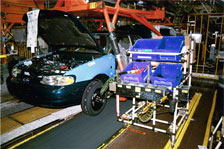 The second example is the NUMMI story. Toyota established a joint-venture with GM at a factory in California known as NUMMI. They put in place their famed Toyota Production System, trained the GM managers on how to run it, and essentially invited the world's biggest automobile manufacturer to become lean. Why would they help their biggest competitor? The author explains that "by helping to raise the level of manufacturing at GM, they were helping society and community, as well as creating high-paying manufacturing jobs for Americans." Is this an extreme example of long-term thinking or what?
 tweak and improve your processes. Homebuilders deal with a barrage of problems on a daily basis: weather, material shortages, unreliable labor, change orders, cost increases, governmental bureaucracy, and many, many more. Without a culture that emphasizes continuous improvement, our chances of long-term survival are less than our chances of developing ulcers, pulling our hair out, and going mad.
 For those of you that haven't read The Toyota Way by Dr. Jeffrey Liker, I highly recommend it. I and other Lean advocates in my company think so highly of this book that we've decided to make it the center-piece of our management training program. We're going to have one training session for each of the 14 principles of the book. As we cover each of them in class, I'll put a supplementary posting on the blog that relates that principle to homebuilding. Hopefully, our readers and trainees will add their comments and create a discussion.
Looking at it in this broad sense, it is apparent that any company in any industry would benefit from Lean, and this includes homebuilders. All builders need to have a good philosophy that focuses on doing the right things, strong processes that do things right, people & partners that keep the bar raised high, and a culture of relentless problem-solving. It's not always easy to see how some of the technical tools of the Toyota Production System apply to construction, but it's the overall approach to running the enterprise that is the key. Lean leads to flexibility, which for a builder is huge when customers want to customize everything from the floor plan to the toilet seat.
 The premise of this web log is that Lean is the best approach to running a business. Based on Ford's original assembly lines, and vastly improved by Taichi Ohno's Toyota Production System, Lean is a way of operating that can be distilled down to two pillars: respect for people, and elimination of waste. Our postings will focus on these two cornerstones, and the many principles that support them. Through continuous learning, we will learn how to take the philosophy of TPS and apply it to the process of building homes.
 Posts
All Comments
Posts
All Comments