Monday, December 11, 2006

Book Club: "The Toyota Way", Chapter 7

Chapter 7 of The Toyota Way explains the first of 14 principles: "Base your management decisions on a long-term philosophy, even at the expense of short-term financial goals."

In this chapter, Dr. Liker breaks down the abstract principle of long-term thinking into smaller and more distinct ideas: a mission greater than earning a paycheck, doing the right thing for the customer, use self-reliance and responsibility to decide your own fate, create a constancy of purpose and place in history. In short, "do the right thing for the company, its employees, the customer, and society as a whole."

Two illustrative examples are given that show Toyota's commitment to long-term thinking. The first is the story of when Lexus tires began to wear-out quicker than expected, prompting Toyota to send all Lexus owners a $500 voucher for new tires. Toyota felt that even though the tires were within industry specs, they owed the customer an apology for not exceeding their expectations. They correctly realized that customer impressions have a ripple-effect on a brand, and that spending cash in the short-term was a good long-term investment.
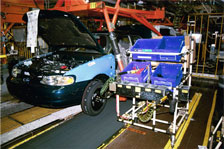
The second example is the NUMMI story. Toyota established a joint-venture with GM at a factory in California known as NUMMI. They put in place their famed Toyota Production System, trained the GM managers on how to run it, and essentially invited the world's biggest automobile manufacturer to become lean. Why would they help their biggest competitor? The author explains that "by helping to raise the level of manufacturing at GM, they were helping society and community, as well as creating high-paying manufacturing jobs for Americans." Is this an extreme example of long-term thinking or what?

The chapter ends with "The Gutting of Chrysler's Culture: A Cautionary Tale." In this section, the author recounts the successful transformation of Chrysler by Lee Iacocca in the 80's, and the subsequent failures of his successors, Daimler, in the 90's. By focusing on short-term cost cutting, Daimler stymied the burgeoning Lean culture that Iacocca had established at Chrysler, leaving them far behind Toyota in the race to the top of the automobile world. Without a long-term philosophy, you can't establish a culture of problem-solving, learning, and improvement.

On a daily basis, homebuilders display an amazing amount of long-term thinking on the job site. Every time we beef up a support beam, double-check an electrical wire, or re-level a grade stake, we are thinking about the customer's long-term interests. Unfortunately, when it comes to business decisions (laying-off employees, buying equipment, offering new services, etc.), we often fall short of the gold standard set by Toyota. Not until an organization commits itself to long-term thinking, even at the expense of short-term financial goals, can it ever hope to become a lean enterprise.

Monday, November 20, 2006

Article About Toyota's Kentucky Plant

Click on the link below to read a great article on the culture and philosophy that Toyota has instilled in its American workers in Kentucky. Warning: this article is very long. It's also very insightful, so it's well worth the time spent reading it.

http://www.fastcompany.com/subscr/111/open_no-satisfaction.html

How does this apply to homebuilding?

With homebuilding, as with any other form of enterprise, there is a need to constantly tweak and improve your processes. Homebuilders deal with a barrage of problems on a daily basis: weather, material shortages, unreliable labor, change orders, cost increases, governmental bureaucracy, and many, many more. Without a culture that emphasizes continuous improvement, our chances of long-term survival are less than our chances of developing ulcers, pulling our hair out, and going mad.

Friday, November 10, 2006

The Toyota Way & Homebuilding

For those of you that haven't read The Toyota Way by Dr. Jeffrey Liker, I highly recommend it. I and other Lean advocates in my company think so highly of this book that we've decided to make it the center-piece of our management training program. We're going to have one training session for each of the 14 principles of the book. As we cover each of them in class, I'll put a supplementary posting on the blog that relates that principle to homebuilding. Hopefully, our readers and trainees will add their comments and create a discussion.

In his book, Dr. Liker groups the 14 principles into the 4P's:
  1. Philosophy = Make Decisions Based on Long-term Thinking, Even at the Expense of the Short-term
  2. Process = Eliminate Process Waste of All Forms (delays, rework, etc.)
  3. People & Partners = Respect, Challenge, and Grow Them
  4. Problem-Solving = Continuous Improvement and Learning

Looking at it in this broad sense, it is apparent that any company in any industry would benefit from Lean, and this includes homebuilders. All builders need to have a good philosophy that focuses on doing the right things, strong processes that do things right, people & partners that keep the bar raised high, and a culture of relentless problem-solving. It's not always easy to see how some of the technical tools of the Toyota Production System apply to construction, but it's the overall approach to running the enterprise that is the key. Lean leads to flexibility, which for a builder is huge when customers want to customize everything from the floor plan to the toilet seat.

Tuesday, October 24, 2006

Introducing the Lean Builder Blog

Please allow me to introduce the Lean Builder Blog. Our goal is to provide a learning forum for Lean thinkers in the homebuilding industry, especially those who are involved with factory-based construction.


The premise of this web log is that Lean is the best approach to running a business. Based on Ford's original assembly lines, and vastly improved by Taichi Ohno's Toyota Production System, Lean is a way of operating that can be distilled down to two pillars: respect for people, and elimination of waste. Our postings will focus on these two cornerstones, and the many principles that support them. Through continuous learning, we will learn how to take the philosophy of TPS and apply it to the process of building homes.